

How To Put A Delay On Camera In Unity
Most game developers have near likely asked themselves "How practise you really create a delay before doing a certain action?".
Trust us, we've asked ourselves this question too.
But how do you actually brand a fourth dimension filibuster before doing an action? The answer is very unproblematic. It'southward past using Coroutines or Invoke!
Only how do you really use information technology?
In this tutorial, nosotros're gonna exist taking a look at how to create a Do After Filibuster function that y'all can employ for something like spawning monsters after a delay, triggering a cutscene afterward a delay, or attack after a filibuster.
But we'll make it equally simple equally possible so you go the idea of how to apply delays in your game.
Getting Started
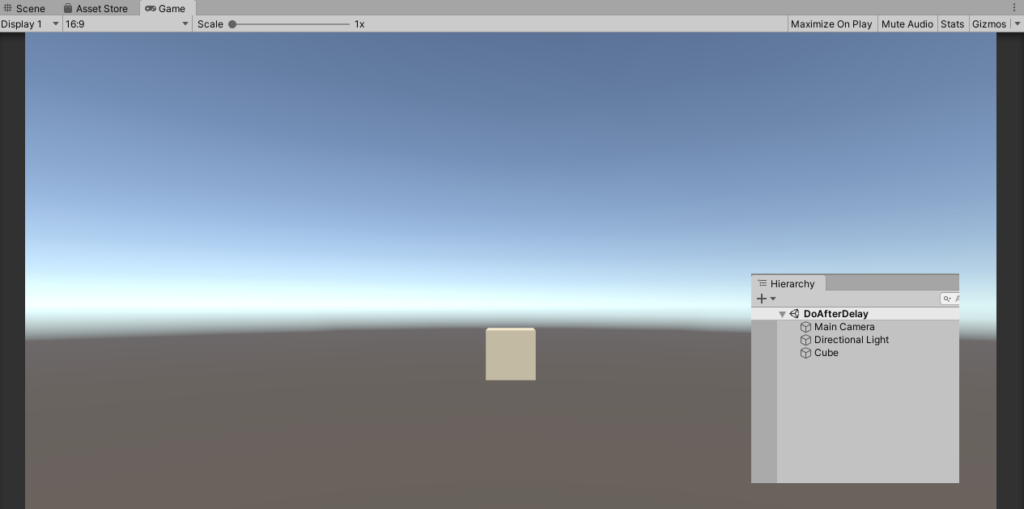
For this tutorial, nosotros don't need to utilize that many game objects just we do need at to the lowest degree one cube for testing the post-obit script.
So open up your Unity, create a new Scene, and add together a new 3D game object like Cube.
How To Create a Delay With Coroutines
I of the easiest means to create a delay is past using a coroutine.
What is a coroutine?
Co-ordinate to Unity's official documentation, a coroutine is a role that has the power to stop or pause an execution. Meaning that anything afterwards the coroutine will not exist executed unless the coroutine is done processing.
Now how does a coroutine works in Unity?
A coroutine works by using an IEnumerator function. With this, you will exist able to use the yield statement and the WaitForSeconds() function to finish your script for a certain period of time.
Once yous have created the function, you will then demand to utilise the StartCoroutine() function to trigger your IEnumarator function.
So with that said, let'southward create a new C# script, name it ChangeColorAfterDelay.cs and re-create the following lawmaking
using System.Collections; using Organisation.Collections.Generic; using UnityEngine; public form ChangeColorAfterDelay : MonoBehaviour { private Renderer _renderer; [SerializeField] private float _time = 3f; // Commencement is called before the get-go frame update void Get-go() { _renderer = GetComponent<Renderer>(); StartCoroutine(ChangeColor(_time)); } public IEnumerator ChangeColor(float t) { yield return new WaitForSeconds(t); _renderer.cloth.color = Colour.red; } }
Code linguistic communication: HTML, XML ( xml ) For this code, we first created a Renderer variable.
Then, right inside the Showtime() role, we used the GetComponent to get the renderer component from the game object that is attached to this script.
Later getting the component, we used the StartCoroutine() function to trigger the WaitForSeconds() office.
Note that you can also pass the name of the IEnumerator office as a string argument for StartCoroutine() similar this:
StartCoroutine("ChangeColor");
Code language: JavaScript ( javascript ) Next, nosotros created the IEnumerator function and gave it a float parameter which we're going to employ for the WaitForSeconds() function every bit the time for waiting. So for case, we accept a value of 3f in our _time variable, the function volition terminate for only 3 seconds.
Later waiting, we then change the color of the cube to ruby-red.
If you lot save this script and use this script to a game object like a cube. You should be able to run across its color modify afterwards 3 seconds.
How To Create a Delay Without Coroutines
At present, we are able to create a delay using coroutines, but how can we do information technology without using coroutines?
The answer is actually very simple and shorter compared to the previous ane. It'due south by using the Invoke() function.
Permit's try it.
Open up the same C# script and copy the following lawmaking:
using Organization.Collections; using System.Collections.Generic; using UnityEngine; public class ChangeColorAfterDelay : MonoBehaviour { private Renderer _renderer; [SerializeField] private float _time = 3f; // Starting time is chosen before the first frame update void Showtime() { _renderer = GetComponent<Renderer>(); Invoke("ChangeColor", _time); } public void ChangeColor() { _renderer.cloth.color = Color.red; } }
Lawmaking language: HTML, XML ( xml ) Unfortunately, Invoke is not maintainable every bit coroutines and so if you are making a circuitous scenario where y'all need to each second, we propose going for coroutines instead of Invoke.
If yous run the game, you should be able to encounter the very same result as the previous one.
Invoke vs Coroutine
Now that we accept learned the two ways of how to create delay functions in Unity, let's talk well-nigh which one is better to apply and which one is non.
Invoke is great and it does its job. All the same, if nosotros talk almost maintainability, Invoke is non as maintainable as coroutines. Invoke runs simply in one time. You call Invoke office and it will wait a couple of seconds and information technology's done.
Merely with Coroutines, you lot are able to dispense each 2d that passes inside the coroutine.
Let's give you an example.
You create a coroutine and it waits for 5 seconds.
When yous run the game, the coroutine starts counting. five… iv… and after reaching 3 seconds, you execute a function. And so the coroutine will proceed counting until information technology reaches 0 seconds.
using System.Collections; using System.Collections.Generic; using UnityEngine; public class ChangeColorAfterDelay : MonoBehaviour { private Renderer _renderer; [SerializeField] individual float _time = 3f; // Commencement is called before the offset frame update void First() { _renderer = GetComponent<Renderer>(); StartCoroutine(ChangeColor(_time)); } public IEnumerator ChangeColor(float t) { while (t > 0) { if (t == 3f) Debug.Log("We reached 3 seconds!"); else Debug.Log(t); t--; yield return new WaitForSeconds(1f); } _renderer.material.color = Colour.red; } }
Code language: HTML, XML ( xml ) With this, yous accept much control with what is happening in your game.
If you lot try the script above, you should have the post-obit output.
Conclusion
Making delays in Unity tin exist a boring task but with coroutines and invoke, we do hope that you are able to create the filibuster function that meets the requirement of your game.
If you're looking for more than but coroutines and delays, try Delay, Invoke, Repeat. It'southward a very awesome plugin that allows you to create delays using not simply time only also conditions.
Disclosure: This article may contain affiliate links, which means we may receive a commission if y'all click a link and purchase something that we accept recommended.
Source: https://weeklyhow.com/unity-delay-function/
Posted by: wendtlitty1942.blogspot.com
0 Response to "How To Put A Delay On Camera In Unity"
Post a Comment